
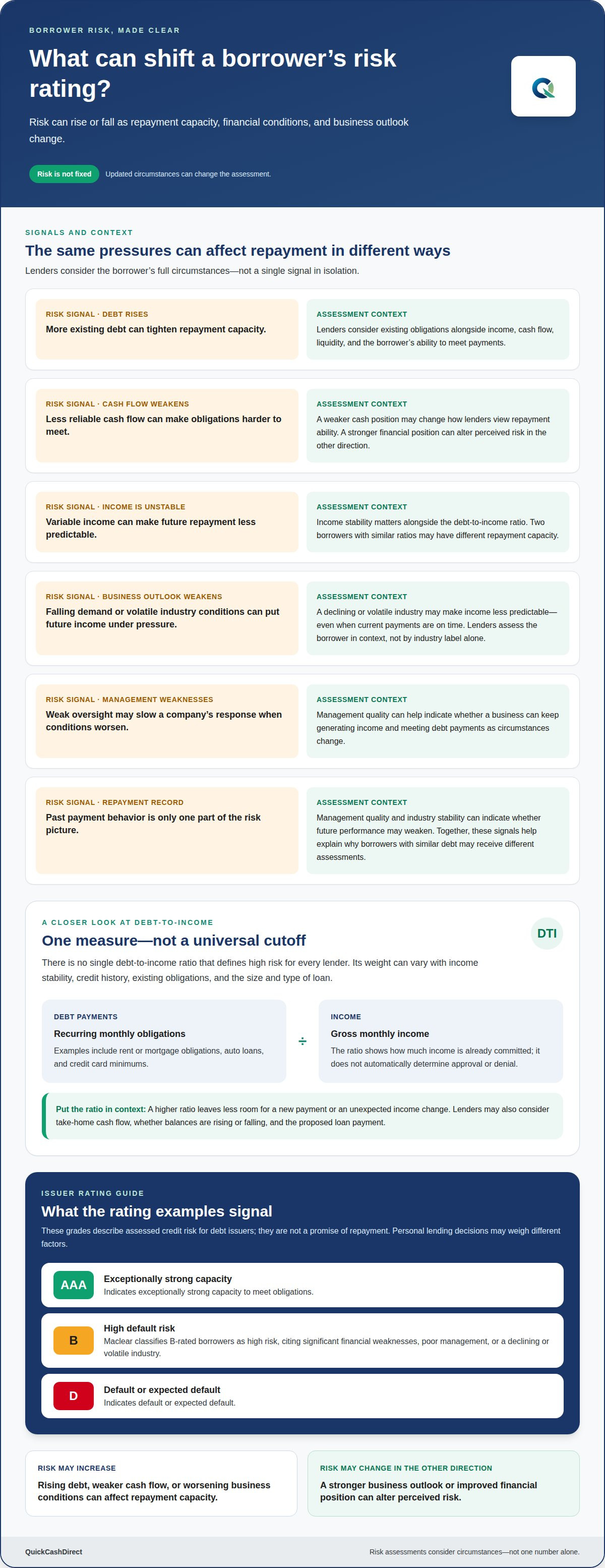
A high-risk rating can change as a borrower’s ability to repay changes. To understand what is considered a high risk borrower, look for signs such as missed payments, high existing debt, unstable cash flow, or a weakening business outlook. For businesses, industry conditions can also affect how lenders assess repayment risk.
A risk rating is not fixed once assigned. Changes in finances, debt, cash flow, or business conditions can shift the assessment. This guide explains the borrower and industry factors that may lead to a high-risk rating, what can cause it to change, and how risk can affect loan approval and borrowing costs. Use these factors to understand what a lender may consider and assess your options with a clearer view of the risks.
Key Takeaways
- Learn how changes in debt, cash flow, repayment capacity, or business outlook can shift a borrower’s assessed risk.
- Identify qualitative warning signs, including financial weaknesses, poor management, and a declining or volatile industry.
- Understand why lenders weigh debt-to-income alongside other details of a borrower’s finances rather than relying on one figure alone.
- See how a high-risk assessment may affect loan approval and borrowing costs, and what factors can influence a lender’s decision.
What can cause a borrower's risk rating to change?
A risk rating can shift when repayment capacity or financial conditions change. Understanding what is considered a high-risk borrower starts with factors such as debt, cash flow, and the ability to meet obligations.
Financial Risk Assessment
Financial risk assessment looks at how reliably a borrower or issuer can meet financial obligations. It matters because weaker cash flow or rising debt can change how lenders and investors view repayment risk. Credit rating agencies consider financial strength, repayment ability, cash flow, liquidity, debt structure, and business outlook. Standard & Poor’s, Moody’s, and Fitch assess debt issuers’ ability to pay bond interest and principal.
Ratings reflect assessed credit risk, not a promise of repayment. AAA indicates exceptionally strong capacity to meet obligations; B signals high default risk, while D indicates default or expected default. Maclear classifies B-rated borrowers as high risk, citing significant financial weaknesses, poor management, or a declining or volatile industry. These grades help explain what is considered a high-risk borrower in an issuer assessment, but personal lending decisions may weigh different factors.
A rating can change as circumstances affecting an issuer or bond change. For example, weaker cash flow or increased debt can affect the assessment of repayment capacity. A stronger business outlook or improved financial position can also alter perceived risk. Higher corporate ratings generally indicate a lower probability of default.
Investors assessing collateralized loan obligations (CLOs) should consider the portfolio and tranche structure, not just a headline rating. CLO portfolios typically hold 150-450 loans across industries. Review the CLO documents, the manager’s track record, and credit enhancement levels. AAA CLO tranches have approximately 60%-65% subordination, but ratings do not guarantee repayment or returns.
Debt-to-Income Ratio Risk
A debt-to-income ratio compares a borrower’s debt payments with income. Lenders use it to assess how much income remains for existing and potential obligations. A higher ratio can signal tighter repayment capacity, especially when cash flow is strained. The ratio is only one part of the assessment; existing debt, income stability, and repayment ability also matter. As income or debt changes, the ratio can shift and influence the overall risk picture.
Qualitative borrower and industry factors
A borrower’s risk profile involves more than financial figures. Lenders may consider management quality, business stability, and industry conditions. These details help indicate whether the borrower can continue meeting obligations when circumstances change.
Yes. Criteria can vary by lender and loan type because assessments weigh repayment ability, credit risk, and available collateral differently. State-specific rules may also affect lending terms and how a loan is assessed.
Management is one meaningful signal. According to Maclear, a B-rated borrower may face high risk because of significant financial weaknesses, poor management, or a declining or volatile industry. For example, weak oversight may leave a company slow to respond when demand falls, putting its ability to generate income and meet debt payments under pressure.
Industry conditions matter because a borrower may operate in a sector exposed to unstable demand or changing business conditions. A declining industry can make future income less predictable, while a volatile industry can bring sharp shifts in sales or operating conditions. These pressures can increase perceived default risk, even when current payments are on time. Lenders assess the borrower in context rather than treating an industry label as the whole credit decision.
Capital and collateral add context. Capital represents the financial resources supporting a borrower’s operations, while collateral is an asset that may secure a loan. Stronger resources or useful collateral can affect how a lender views potential losses, but they do not erase concerns about weak management or an unstable business outlook. For example, a company with valuable equipment but falling demand may have assets that support the assessment, while its ability to generate income remains a concern.
Separate the signals. A past payment record describes repayment behavior; management quality and industry stability can indicate whether future performance may weaken. Together, these factors help explain why two borrowers with similar debt may receive different assessments of credit risk, default risk, and their ability to meet obligations.
What debt-to-income ratio is considered high risk by lenders?
There is no single debt-to-income ratio that defines a high-risk borrower for every lender. Lenders use the ratio as one measure of repayment capacity, alongside income stability, credit history, and the size and type of requested loan. The same ratio can carry different weight depending on the borrower’s income, existing obligations, and loan terms.
The debt-to-income ratio compares recurring monthly debt payments with gross monthly income. To calculate it, add ongoing payments such as rent or mortgage obligations, auto loans, and credit card minimums. Compare their total with income before taxes. The result shows how much income is already committed, not whether a borrower will automatically qualify or be declined.
A higher ratio leaves less room in a budget for a new payment or an unexpected income change. For example, a borrower whose monthly income depends on variable work may have less predictable repayment capacity than someone with stable earnings, even if their ratios are similar. A lender may also consider whether existing balances are rising or falling. These details put the ratio in context.
- Review recurring payments: Include ongoing debt obligations, not one-time purchases.
- Separate income from debt: Use gross income for the ratio, then consider whether take-home cash flow supports payments.
- Assess the new loan: Account for how its payment would affect the borrower’s remaining income.
Treat the ratio as a warning signal, not a verdict. A high figure may raise concerns because less income remains for additional obligations. A lower figure may indicate more room, but it does not erase other credit risks. Lenders weigh the ratio against the borrower’s broader financial picture and the loan being considered. For a clearer assessment, focus on the payment burden, income reliability, and how the proposed obligation changes both.
How does being classified as a high-risk borrower affect loan approval and borrowing costs?
A high-risk assessment can make approval harder because lenders see greater uncertainty around repayment. They may weigh the borrower’s ability to meet existing obligations, income stability, and the requested loan’s terms. The rating informs the decision, but does not determine the outcome on its own.
Higher credit ratings generally allow issuers to borrow at lower costs, while lower ratings are associated with higher borrowing costs. Maclear says lower-rated projects typically carry higher interest rates to compensate for their higher probability of default. For borrowers, risk can affect both access to credit and the terms of an approved loan.
Approval and cost are related but separate parts of the decision. A lender may approve a borrower while accounting for assessed risk in the loan terms. Another application may not meet that lender’s criteria. The borrower’s income, existing debt, repayment history, and loan structure help explain why applications can lead to different decisions.
Consider two applicants requesting similar loans. If one has more stable income and fewer existing obligations, a lender may view that applicant as better positioned to repay. If the other has weaker repayment capacity, the lender may assess greater default risk. That difference can affect approval and borrowing costs, even when the requested amounts are similar.
Focus on the full commitment, not approval alone. A higher interest rate increases borrowing costs over the loan term. Existing debt can also leave less income available for payments. Before accepting an offer, consider how the payment fits alongside current obligations and whether the terms remain manageable if your income changes.
Need to explore borrowing options with a high-risk profile? Review available borrowing options and consider how any new payment fits your budget.
QuickCashDirect
QuickCashDirect offers short-term borrowing options for readers weighing their next step after a high-risk assessment. Its Payday Loans, Cash Advance, Payday Loans Online, and loans for bad credit may help address an immediate financial need. Review the repayment obligation and how it fits your budget before choosing any loan. A high-risk rating can affect approval and borrowing costs, so focus on the full terms and your ability to repay. If you’re considering borrowing, compare the commitment with your current financial obligations and choose an option that suits your situation. For questions about your options, contact QuickCashDirect.
Choose a Next Step You Can Manage
Knowing what is considered a high-risk borrower can help you approach a borrowing decision with clearer expectations. Before taking on a new commitment, consider its place in your broader budget. A loan should address a need without creating pressure that makes future payments harder to manage. If the repayment terms do not fit your circumstances, reconsider the amount or timing of the expense.
If you are weighing short-term borrowing, take a practical next step: understand the obligation, review how repayment fits your finances, and decide whether proceeding makes sense for you. A risk label is useful context, not your entire financial story. Focus on the decision in front of you and move forward at a pace that supports responsible repayment.
Contact QuickCashDirect to discuss your options. Take your next step with care and confidence.
Frequently Asked Questions
What factors make someone a high-risk borrower?
Risk often rises when several repayment concerns appear together. For example, a borrower with irregular income, growing balances, and a recent missed payment may seem less able to handle another obligation than someone with steady income and manageable debt. Lenders may also consider the loan’s purpose and terms. Looking at how these factors interact gives a clearer picture than treating one warning sign as decisive.
What credit score is considered high risk for borrowing in the United States?
There is no single credit score cutoff that defines high risk for every U.S. loan. Lenders can use different scoring models and assess scores alongside the application, requested loan, income, and repayment capacity. A score may affect the assessment, but it does not describe every part of a borrower’s finances. For example, a recent income change may matter even when the score has not changed.
How do lenders assess high-risk borrowers beyond credit scores?
Lenders can consider whether an application presents a consistent, workable repayment picture beyond the score. For example, they may compare the requested payment with the borrower’s income and existing commitments. They can also consider the loan’s structure and any available security. If your finances have changed recently, provide clear and accurate application details to show your current situation rather than relying only on older credit history.
How do income, employment history, and collateral affect borrower risk?
Income helps show whether payments fit a borrower’s finances, while employment history can provide context about income stability. A recent job change does not automatically mean a borrower cannot repay, but variable earnings can make payment planning harder. Collateral can give a lender an asset tied to the loan, yet it does not replace repayment ability. For instance, equipment may secure borrowing while business income remains uncertain.
Which types of loans are available to high-risk borrowers in the United States?
Options can include payday loans, cash advances, and online payday loans, depending on the lender and the borrower’s circumstances. QuickCashDirect connects borrowers with lenders; it isn’t a direct lender. Its platform offers access to these short-term options, including loans for bad credit. Before accepting any offer, review the lender’s agreement and make sure the repayment schedule fits your budget.
How can borrowers reduce their risk profile and improve their chances of approval?
Build a clearer repayment picture by paying current obligations on time, reducing outstanding balances where possible, and avoiding new borrowing that strains your budget. Keep income and employment information accurate in applications. For example, if your income varies, organize records that show its pattern. Request an amount that fits your finances and carefully review the payment schedule before accepting an offer. These steps can help show control over existing commitments.