
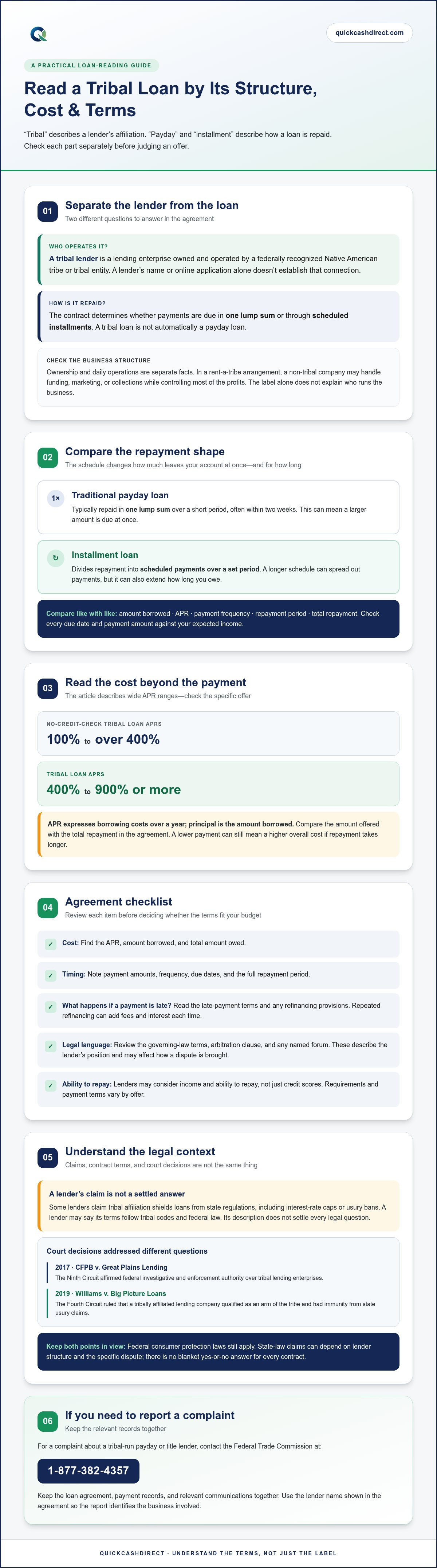
A tribal loan isn’t automatically a payday loan. A tribal lender is a lending enterprise owned and operated by a federally recognized Native American tribe or tribal entity. To understand what a tribal lender is, separate who operates the lender from how a particular loan is repaid.
It’s easy to group these loans together, especially when both may be offered online for short-term needs. But repayment structure matters: payday loans are typically due in one lump sum, while installment loans use scheduled payments over time.
This guide explains how tribal lenders and tribal lending enterprises work, how payday and installment loans differ, and why tribal and state laws can affect loan terms. You’ll learn how to assess what a loan requires before accepting an offer.
Key Takeaways
- Look beyond a lender’s name to understand the tribal enterprise’s ownership and how it is structured.
- Compare the APR, repayment schedule, and total obligation before deciding whether a loan fits your budget.
- Review the agreement’s governing-law and dispute-resolution terms to understand the legal framework it describes.
- Learn why tribal sovereignty can affect state-law claims without assuming it removes federal consumer protections.
What Is a Tribal Loan?
A tribal loan is credit offered by a lending enterprise owned and operated by a federally recognized Native American tribe or tribal entity. A tribal lender is the enterprise offering that consumer loan. The tribal connection is ownership or operation, not simply an online application or a lender’s name.
Federally recognized tribes are sovereign nations with authority to govern themselves and their enterprises, according to the U.S. Department of the Interior, Bureau of Indian Affairs. Tribal lending enterprises set lending policies, underwriting standards, and consumer disclosures under applicable tribal and federal laws. Tribal codes govern their rates and terms, while federal consumer protection laws still apply.
Tribal lending means providing financial services through tribally owned or operated enterprises. Some tribes use lending as part of economic development to create employment and generate revenue for tribal programs. That purpose explains how a lending business may contribute to tribal economic activity, but it doesn’t tell you a loan’s cost, repayment schedule, or suitability. Those details are in the loan agreement.
Look closely at the lender’s affiliation. Some payday and title lenders are owned by, or associated with, federally recognized tribes and may claim to operate under tribal sovereignty. In a rent-a-tribe arrangement, a non-tribal company may handle funding, marketing, or collections while controlling most of the profits. The label alone doesn’t explain who runs daily operations or how the business is structured. Ownership and operational roles are separate facts.
To report a complaint about a tribal-run payday or title lender, contact the Federal Trade Commission at 1-877-382-4357. Keep the loan agreement, payment records, and relevant communications together. Use the lender name shown in the agreement so your report identifies the business involved.
Are Tribal Loans the Same as Payday Loans?
No. “Tribal” describes a lender’s affiliation; “payday” describes a loan’s structure. The agreement shows whether repayment is due in one lump sum or through scheduled payments.
Loan Amounts and Estimated APRs
Loan amounts and annual percentage rates (APRs) vary by product and lender. No-credit-check tribal loan APRs can range from 100% to over 400%, while tribal loan APRs can range from 400% to 900% or more. These ranges show why the specific offer matters more than a general label.
APR expresses borrowing costs over a year, while the amount borrowed is the principal. Compare the amount offered with the total repayment stated in the agreement. A lower payment can still mean a higher overall cost if repayment takes longer. Review the APR, payment schedule, and total amount owed together before accepting.
Repayment Periods
A tribal installment loan divides repayment into scheduled payments over a set period. A traditional payday loan is typically repaid in one lump sum over a short period, often within two weeks. That difference affects how much must leave your account at once and how long payments continue.
Compare each due date and payment amount with your expected income. A longer schedule spreads out payments, but it can also extend how long you owe. The written timeline helps you see the full commitment before agreeing.
Lenders may consider income and ability to repay, not just credit scores. Requirements vary, so approval criteria and payment terms can differ between offers.
Compare offers using the same details: amount borrowed, APR, payment frequency, repayment period, and total repayment. Read the agreement for late-payment terms and any refinancing provisions. Repeated refinancing can add fees and interest each time, so check whether the original schedule fits your budget.
If you’re comparing short-term choices, review online payday loan options alongside the repayment terms of any tribal loan.
How tribal lenders describe their legal jurisdiction
Tribal lenders may explain their legal authority by referring to tribal codes and sovereignty. That position can affect which state rules they say apply to a loan.
Tribal Lenders’ Jurisdiction Claims
Some lenders claim tribal affiliation shields their loans from state regulations, including interest-rate caps or usury bans. They may say their terms follow tribal codes and federal law instead. For borrowers, this claim matters because it can shape the agreement’s stated governing law and dispute process. Read those clauses carefully: a lender’s description does not settle every legal question.
Agreements may require arbitration under tribal law. This can affect how you bring a dispute, so note the arbitration clause, named forum, and governing-law language. Tribal affiliation alone doesn’t explain how an enterprise is structured or whether a court will accept its jurisdiction claim.
Tribal Lender Legality in the United States
Tribal lending operates in the United States, but that doesn’t mean every lender or loan receives the same legal treatment. Federal consumer protection laws apply, while state-law claims can depend on the lender’s structure and the specific dispute. There isn’t a blanket yes-or-no answer for every contract.
In 2017, the Ninth Circuit affirmed federal investigative and enforcement authority over tribal lending enterprises in CFPB v. Great Plains Lending. In 2019, the Fourth Circuit ruled in Williams v. Big Picture Loans that a tribally affiliated lending company qualified as an arm of the tribe and had immunity from state usury claims. Those decisions address different legal questions, not a universal rule for all borrowers.
Federal consumer protections remain relevant. Courts have enforced federal consumer protection laws against tribal lending enterprises and invalidated some contract provisions based solely on tribal law. Distinguish a lender’s jurisdiction claim from the laws that may apply to a dispute. The agreement’s ownership structure, governing-law terms, and arbitration language show the position being asserted; court decisions show that such claims can be challenged.
Tribal payday loans and installment loans
Tribal payday loans and installment loans can both come from tribally affiliated lenders, but their timing and repayment experience differ. Applying and managing payments online may be convenient, yet the written schedule still determines what you owe and when.
Tribal payday loans are often intended to be repaid by the next payday. This short window makes payment timing especially important: compare the due date with your expected income and other scheduled bills. Many tribal lenders operate online, where borrowers can apply, receive decisions, and manage repayments electronically.
Installment loans use scheduled payments over a predetermined period. Some applications for tribal installment loans could be approved within 1 hour, but timing alone doesn’t show whether the schedule fits your budget. Focus on the payment dates and the full repayment timeline in the agreement. A set schedule can help you plan, but each payment still competes with rent, utilities, and other costs.
Loan funds may cover personal needs such as medical expenses, home repairs, or debt consolidation. Some tribal lenders offer deposits on the same day or next business day after approval. The use of funds and deposit timing depend on the offer’s terms, so don’t assume the approved amount will arrive by a particular time.
Credit reporting also varies. Some tribal lenders report payment history to major credit bureaus; others don’t. If building credit matters to you, review the agreement’s reporting terms before signing. Payment history can affect your credit profile only if the lender reports it, and on-time payments remain important.
Watch for repeat refinancing. Payday and tribal lenders may encourage borrowers to refinance repeatedly, adding fees and interest each time. Before accepting a new loan to cover an existing balance, compare the revised obligation with the original schedule. If you’re considering a tribal loan, review tribal loan options and read the repayment terms closely.
QuickCashDirect: Payday Loans
QuickCashDirect offers payday loans, cash advances, online payday loans, and loans for bad credit. If you need to compare short-term borrowing options, review the repayment schedule and total obligation before choosing a loan. The key difference is the product’s terms, not just whether a lender uses a tribal affiliation.
Use what you’ve learned to assess an offer: identify the payment schedule, when repayment begins, and what the agreement says about the lender’s jurisdiction. Choose an option only if its terms and repayment plan fit your circumstances. QuickCashDirect connects borrowers with lenders as they weigh short-term needs against repayment responsibilities.
Visit QuickCashDirect online to explore its payday loan options.
Choose a Loan With a Clear Repayment Plan
Knowing what a tribal lender is gives you a starting point, but your next decision should focus on how repayment will fit your budget. Consider how the payment schedule works alongside your regular expenses. Borrow only when the terms make sense for your circumstances.
QuickCashDirect offers payday loans, cash advances, and online payday loans for people exploring short-term financial options. Review the details carefully and keep your priorities clear: understand the obligation, plan for repayment, and avoid taking on a payment you can’t manage.
If you’re ready to explore available options, visit QuickCashDirect. Make your next step with a clear view of the commitment, and choose a path you can approach with confidence.
Frequently Asked Questions
What regulatory challenges do tribal lenders face?
Tribal lenders face questions about how tribal codes, state lending rules, and federal consumer protections apply to their operations. Disputes may focus on whether an enterprise qualifies as an arm of a tribe and whether a contract’s jurisdiction or arbitration clauses can be enforced. A lender’s legal position may not resolve every dispute, so the agreement and relevant court decisions both matter.
Do tribal lenders report to credit bureaus?
Some tribal lenders report payment history to major credit bureaus, while others don’t. Don’t assume that paying on time will build credit or that missed payments will appear on a report. Keep your own payment confirmations and account statements. If you review your credit file, compare reported account details with your loan records and use the relevant reporting process to address errors.
How can I verify if a tribal lender is legitimate?
Start with the legal lender name in the agreement, then compare it with the business name on the application and payment instructions. Look for a clear tribal affiliation, the enterprise’s role, written loan terms, and a named dispute process. Be cautious if those details conflict or a non-tribal company appears to control key operations while the tribal connection remains unclear.
What Should You Consider Before Applying?
Before applying, map each scheduled payment against your income and essential bills. Consider what happens if an expected deposit arrives late, and don’t rely on refinancing as your repayment plan. Review the agreement’s payment dates, total repayment, and dispute terms. If the scheduled payments would leave too little for necessities, the loan may add pressure rather than solve the immediate shortfall.
What is tribal lending?
Tribal lending is a financial service provided through an enterprise affiliated with a federally recognized tribe. For borrowers, the term describes the lender’s tribal connection, not one fixed loan design. A tribal loan may use payday-style or installment repayment. Understanding what a tribal lender is helps separate the enterprise’s affiliation from the loan’s repayment obligations.
What legal protections do borrowers have?
Borrowers retain federal consumer protection rights, and courts have applied federal protections to tribal lending enterprises in some cases. A contract’s tribal-law language does not automatically settle whether a consumer claim can proceed. Keep the agreement and payment records if a dispute arises. Consumers can report complaints about tribal-run payday or title lenders to the Consumer Financial Protection Bureau at 1-855-411-2372.