
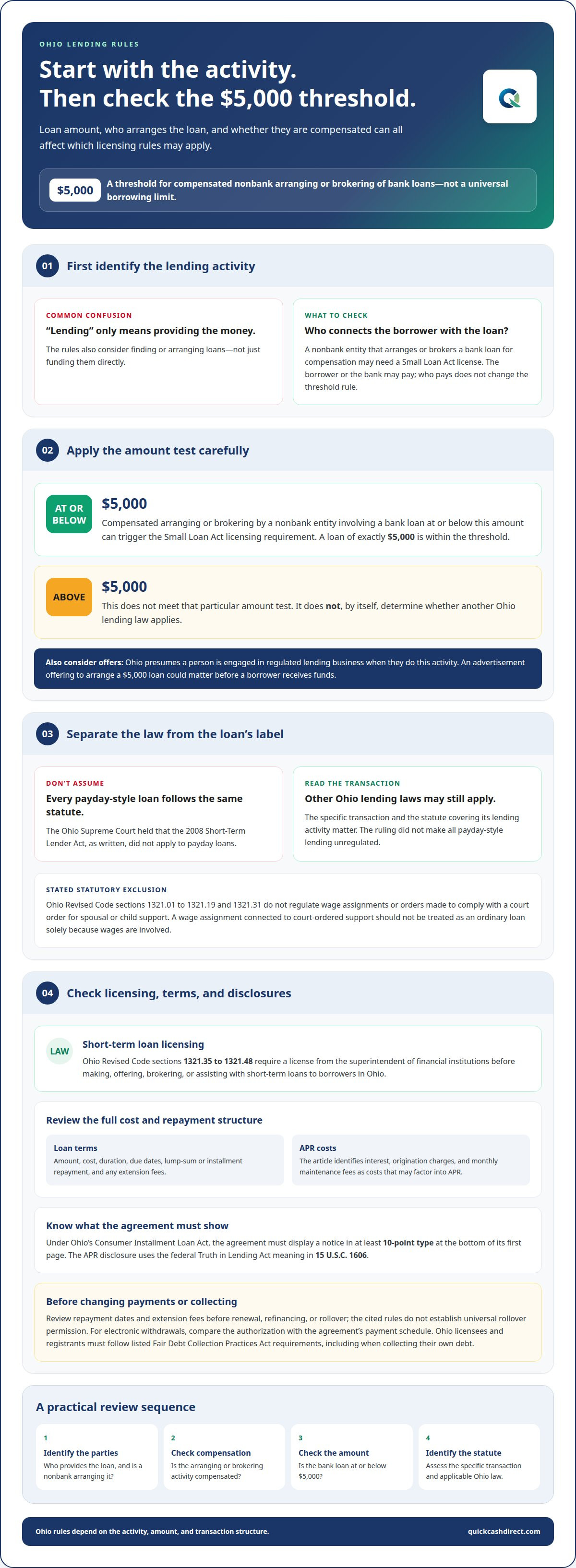
The $5,000 threshold can trigger a licensing requirement for compensated loan arranging. Nonbank entities that arrange or broker bank loans of $5,000 or less must obtain a Small Loan Act license in Ohio. Understanding Ohio’s Short-Term Loan Act also means distinguishing its rules from other lending laws: according to Ohio Laws and Administrative Rules, Ohio Revised Code sections 1321.35 to 1321.48 govern licensing before a person makes, offers, brokers, or assists with short-term loans to borrowers in the state.
The rules can be easy to confuse because a loan’s amount, structure, and the activity around it all matter. This guide explains what lending activity the law covers, how the $5,000 threshold applies, and how licensing and regulation work. You’ll get a clear starting point for understanding which rules may apply to a lending arrangement in Ohio.
Key Takeaways
- For bank loans of $5,000 or less, compensated nonbank arranging or brokering can trigger Ohio Small Loan Act licensing requirements.
- Ohio Laws and Administrative Rules states that a license from the superintendent of financial institutions is required before making, offering, brokering, or assisting with short-term loans under Ohio Revised Code sections 1321.35 to 1321.48.
- Don’t assume every payday-style loan falls under the same law; the loan’s structure and the lending activity affect which rules apply.
- When reviewing loan costs, account for the interest, origination charges, and monthly maintenance fees that may factor into the annual percentage rate.
Definition of lending activity and the $5,000 threshold
Lending activity includes making, finding, or arranging loans, not just providing the funds. Understanding Ohio’s Short-Term Loan Act starts with identifying the activity and the parties involved. In Ohio, a nonbank entity that receives compensation for arranging or brokering a bank loan may need a Small Loan Act license. The borrower or the bank may pay that compensation; who pays does not change this threshold rule.
The $5,000 threshold is the loan amount at or below which compensated nonbank arranging or brokering of bank loans can trigger this licensing requirement. A bank loan of exactly $5,000 falls within the threshold. A loan above $5,000 does not meet this particular amount test, though that distinction alone does not determine whether another Ohio lending law applies. This is one key point for understanding Ohio’s short-term loan act.
Arranging or brokering means helping connect a borrower with a loan, rather than necessarily lending the money directly. Consider the activity, the loan amount, and any compensation together.
Ohio presumes a person is engaged in the regulated lending business when they do this. An advertisement offering to arrange a $5,000 loan could therefore matter before a specific borrower receives funds. To assess a transaction, identify who provides the loan, whether a nonbank entity arranges it, whether that entity is compensated, and whether the amount is within the threshold. This step-by-step approach supports a practical understanding of Ohio’s short-term loan act without treating the threshold as a universal borrowing limit.
Ohio short-term loan licensing and regulation
Ohio regulation combines state licensing rules with federal consumer protections. Ohio Laws and Administrative Rules says a person must obtain a license from the superintendent of financial institutions before making, offering, brokering, or assisting with short-term loans to borrowers in the state under Ohio Revised Code sections 1321.35 to 1321.48.
Loan Costs, Amounts, and Repayment
Loan terms cover the amount, cost, duration, and repayment schedule. The material does not state a maximum term. Review the due dates, whether repayment is due all at once or in installments, and any extension fees. Alternatives include nonprofit credit counseling, a payment plan with a creditor, or borrowing from a bank, credit union, family, or friends.
Borrower Disclosures and Loan Changes
Loan disclosures explain key terms and costs in the agreement. Under Ohio’s Consumer Installment Loan Act, the agreement must display a notice in at least ten-point type at the bottom of its first page. The annual percentage rate disclosure uses the federal Truth in Lending Act meaning in 15 U.S.C. 1606. Renewal, refinancing, and rollover change or extend an existing loan. Review repayment dates and any extension fees before agreeing to a change; the cited rules do not establish a universal rollover permission.
Collections, Withdrawals, and Complaints
Collection protections govern how lenders pursue repayment. Ohio licensees and registrants must follow listed Fair Debt Collection Practices Act requirements, including when collecting their own debt. For electronic withdrawals, compare the payment authorization with the agreement’s repayment dates and payment schedule. To document a concern, keep the agreement and payment records, then review the lender’s complaint history with the Ohio Attorney General’s Office and the Better Business Bureau. If considering a loan option, explore online payday loans and review the repayment terms before proceeding.
Applicability of the Short-term Loan Law
Applicability means deciding whether a particular loan falls under Ohio’s Short-Term Lender Act. The 2008 law was intended to address payday lending, but the Ohio Supreme Court held that the Act, as written, did not apply to payday loans. That distinction matters: a payday-style loan may still be subject to other Ohio lending laws, depending on the lending activity and applicable statute.
Judicial interpretation explains how courts read a law’s wording. A lower court ruled that Ohio lawmakers intended the 2008 Act to cover payday loans. The Ohio Supreme Court disagreed about the Act’s scope as written. Justice Judith French noted that the General Assembly could have defined “short-term loan” more broadly if it intended the Act to be the sole authority for payday-style loans. The ruling therefore did not make all payday-style lending unregulated.
Statutory exclusions identify transactions that specific provisions do not regulate. Ohio Revised Code sections 1321.01 to 1321.19 and 1321.31 do not regulate wage assignments or orders made to comply with a court order for spousal or child support. For example, a wage assignment connected to a court-ordered support obligation falls within that stated exclusion. It should not be treated as an ordinary loan solely because wages are involved.
To assess a loan, identify the transaction first: determine whether it involves an extension of credit, a wage assignment, or a court-ordered support payment. Next, distinguish the 2008 Short-Term Lender Act from other Ohio lending statutes. The Supreme Court’s interpretation means the label “payday loan” alone does not establish which law governs. The specific transaction and the statute covering its lending activity determine the relevant framework.
What are the interest rate, fees, and loan amount limits under Ohio short-term loan law?
Annual percentage rate (APR) expresses borrowing costs as an annual rate. Ohio’s APR calculation includes interest, loan origination charges, and monthly maintenance fees authorized under section 1321.40. APR disclosures use the federal Truth in Lending Act meaning in 15 U.S.C. 1606. Compare the APR and each listed charge to understand the full cost, not just the stated interest.
Interest-rate authority is the legal basis that allows a lender to charge a particular rate. An 8% annualized rate is identified as typical for Ohio consumer loans unless alternative interest-rate authority exists. The 2008 Ohio Short-Term Loan Act included a 28% annual interest-rate cap, but that figure should not be treated as a universal cap for every loan type. The Ohio Supreme Court ruled the Act, as written, did not apply to payday loans.
Rates reported for payday lending can describe different measures. The Ohio Department of Commerce reported a weighted contracted annual interest rate of 148% for payday lending. That reported rate is distinct from the law’s APR calculation and from a statutory cap. Check which lending law governs the product before comparing a quoted rate with a specific legal limit.
Loan amount limits are maximum or minimum amounts set by the legal framework governing a loan. The applicable limit depends on the statute and authority used for that product; the $5,000 threshold discussed earlier concerns licensing activity, not a universal borrowing cap. Identify the governing law, then review the agreement’s principal, interest, origination charges, and monthly maintenance fees. Also account for any extension fee if repayment is late.
For a practical review, separate the principal from every charge, identify the stated APR, and note the repayment date. If you need to consider a borrowing option, review payday loan options and examine the repayment terms before accepting an agreement.
QuickCashDirect
QuickCashDirect connects borrowers with lenders offering short-term financial options for urgent expenses. Its options include payday loans, cash advances, online payday loans, and loans for bad credit. This guide explains Ohio’s lending laws and licensing rules; choosing whether to borrow is a separate decision.
If you’re considering a loan, use this information to understand the legal framework, then review the proposed agreement’s repayment dates, APR, and charges. Make sure the schedule fits your budget before proceeding. A loan may not suit every situation, so consider whether another payment arrangement or borrowing alternative better meets your needs.
Contact QuickCashDirect to discuss the available short-term loan options for your situation.
Choose Your Next Step With Confidence
Use your understanding of Ohio’s Short-Term Loan Act as a starting point for a broader decision: will borrowing address a one-time cash-flow gap, or could repayment leave you short before your next income arrives? This distinction can help you decide whether to explore a loan or consider another way to manage the expense. Set a borrowing limit based on what you can repay while meeting essential obligations.
Before moving forward, focus on the specific need, the repayment commitment, and how the choice fits your financial priorities. If the terms don’t work for your budget, don’t accept them. A considered decision is better than a rushed one.
For help exploring available options, contact QuickCashDirect today. Take the next step at a pace that works for you.
Frequently Asked Questions
What is the Ohio Short-Term Loan Act, and what loans does it cover?
The Ohio Short-Term Lender Act is a state law passed in 2008 to limit payday lenders’ charges and potential repercussions when borrowers fail to pay. Its title doesn’t mean it governs every payday-style loan: the Ohio Supreme Court found that the Act, as written, didn’t apply to payday loans. Ohio had authorized payday lending through the Check Cashing Act in 1996, showing why a loan’s legal framework can depend on the authority used.
What licensing requirements apply to Ohio short-term lenders?
Ohio Laws and Administrative Rules states that people making, offering, brokering, or assisting with short-term loans to Ohio borrowers need a license from the superintendent of financial institutions. A separate Small Loan Act licensing rule can apply to compensated nonbank brokers arranging bank loans of $5,000 or less. However, loans governed by the Short-Term Loan Act, General Loan Law, or Consumer Installment Loan Act are exempt from that specific Small Loan Act requirement.
How does Ohio short-term loan law compare with federal payday lending rules?
Ohio law sets licensing requirements for short-term lending, while federal consumer protections cover matters such as APR disclosures and debt collection. This article does not describe federal payday lending rules more broadly.
What is the maximum loan term and repayment schedule for an Ohio short-term loan?
The material gives no maximum term; it says Small Loan Act licensees may not make loans with a duration of one year or less. Repayment may be due all at once or in installments, so review the agreement’s due dates and schedule.