
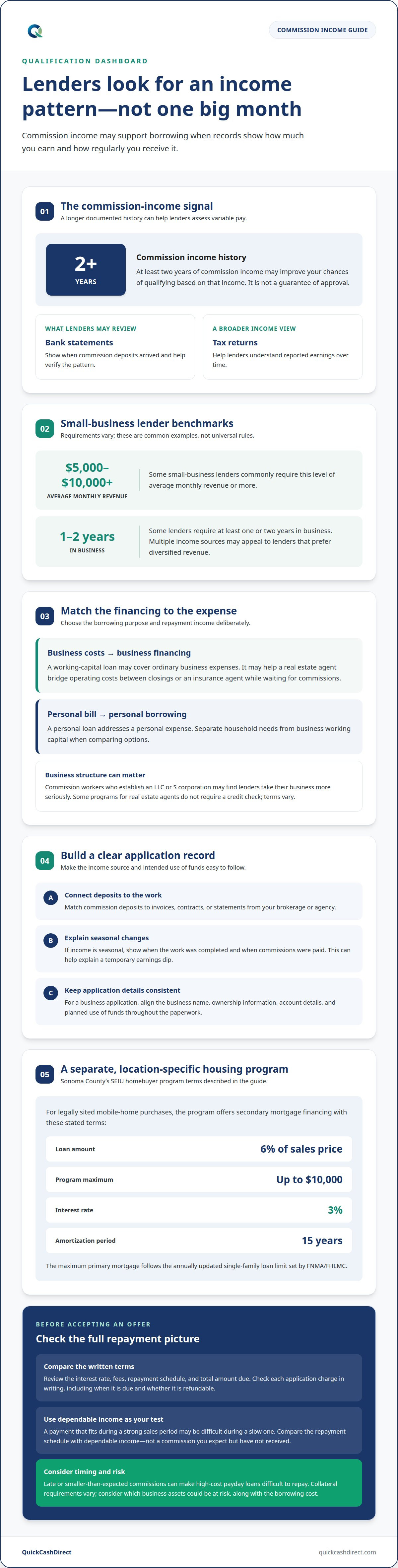
Commission income doesn’t automatically rule out borrowing. Loans for commission workers may be available when income records show a consistent pattern. At least two years of commission income may improve your chances of finding a loan based on that income. Lenders may review bank statements and tax returns to understand how much you earn and how regularly you receive it.
Variable pay can make a loan application feel uncertain. You may wonder whether a strong month can offset a slower one, which records to gather, or how fees affect the amount you repay. The key is to understand how lenders assess income that changes over time, rather than focusing on a single commission check.
This guide explains financing options that may fit a services business, how commission history and income sources can shape qualification, and what documents commonly support an application. You’ll also learn what to look for in fee and repayment terms, so you can assess the next step with a clearer view of the process.
Key Takeaways
- Separate business financing needs from urgent personal cash needs to narrow down which type of borrowing may fit.
- A formal business structure, such as an LLC or S corporation, may help lenders assess a commission-based business.
- Compare fees alongside repayment timing and the total amount due before accepting an offer.
- Organize your business details and application paperwork so you can respond efficiently when a lender requests information.
Financing for real estate agents, insurance agents, and financial advisors
In the United States, commission workers may consider small-business financing or specialized programs for commission-based workers. Some programs for real estate agents don’t require a credit check. Terms vary, so match the type of financing to the expense and the income you’ll use to repay it.
For a real estate agent, a business loan may help cover operating costs between closings. An insurance agent might need working capital while waiting for commissions to arrive. A financial advisor could compare business financing with personal borrowing, based on whether the expense belongs to the business or household. Commission workers who establish an LLC or S corporation may find lenders take their business more seriously.
Independent contractors and gig workers can also look at small-business financing. Some small-business lenders commonly require average monthly revenue of $5,000 to $10,000 or more. Some require at least one or two years in business. Workers with several income sources may appeal to lenders who prefer diversified revenue. A working-capital loan may cover ordinary business expenses, while a personal loan addresses a personal bill.
Credit union rules also shape incentive compensation. Under 12 CFR 701.21(c)(8)(i), federally insured credit union officials and employees, and their immediate family members, are generally prohibited from receiving commissions, fees, or other compensation connected to credit union loans. The rule applies to federally insured, state-chartered credit unions through 12 CFR 741.203(a). A proposed clarification would allow lending metrics in incentive or bonus compensation based on a credit union’s overall financial performance.
Below-market secondary mortgage financing is a separate housing option. Sonoma County’s SEIU homebuyer program offers legally sited mobile-home purchase loans equal to 6% of the sales price, up to $10,000, at 3% interest, amortized over 15 years. Its maximum primary mortgage follows the annually updated single-family loan limit set by FNMA/FHLMC.
High-cost payday loans can create repayment pressure if a commission arrives late or falls short. Before borrowing, compare the full repayment obligation with dependable income, not an unusually strong sales month.
Commission workers may consider small-business financing or specialized programs for commission-based workers. Some programs for real estate agents don’t require a credit check.
How variable commission income affects loan qualification
For loans for commission workers, lenders often assess documented income patterns rather than a single strong month. At least two years of commission income may improve your chances of qualifying based on that income. Lenders may review bank statements and tax returns to verify deposits and income history.
Build a clear income record before applying. Match commission deposits to invoices, contracts, or statements from your brokerage or agency. If income is seasonal, use records to show when the work was completed and the commission paid. This can help explain a temporary dip in earnings.
Rules and assistance programs vary by state and loan purpose. Collateral requirements can vary among lenders offering workers’ compensation loans. Consider which business assets could be at risk, along with the borrowing cost.
For credit union loans, compensation restrictions relate to commissions, fees, or other payments received by certain credit union officials, employees, and their immediate family members. This is different from how a commission worker documents personal income. Keep the two issues separate when reviewing loan terms.
When comparing loans for commission workers, review the interest rate, fees, repayment schedule, and total amount due in each written offer. A payment that fits during a strong sales period may become difficult during a slow one. Check whether the schedule works with dependable income, not a commission you expect but haven’t received.
Primary mortgage limits set a maximum loan size separately from income qualification. The maximum primary mortgage under Sonoma County’s SEIU homebuyer program follows the annually updated single-family loan limit set by FNMA/FHLMC. Documented earnings still matter when assessing whether the payment is manageable.
If you need personal cash rather than business working capital, consider online payday loans as a separate option. Review the repayment terms against your expected commission timing before choosing.
Application fee and required forms
Before applying, distinguish any application charge from the loan amount and repayment cost. Review each fee in writing: when it is due, whether it is refundable, and how it affects the total amount owed. Don’t rely on a verbal summary. Keep a copy of the offer and fee schedule to compare terms.
Prepare the income records lenders may use to assess commission earnings. Bank statements show when payments arrived, while tax returns provide a broader picture of reported income. Organize records by year and account. If statements combine personal and business transactions, identify commission deposits so the income source is clear.
A business loan application may ask about the company, its ownership, and how the funds will be used. Gather relevant business records and account statements, then make sure the details match throughout the application. For example, use the same business name and account information in each section. A personal loan application focuses instead on you and your personal income.
- Income documentation: Organize bank statements and tax returns that show commission deposits and reported earnings.
- Business details: Keep the business name, ownership information, and intended use of funds consistent.
- Fee terms: Record each charge, when it applies, and how it changes the repayment obligation.
Application forms vary by lender and financing type. Read each question carefully, answer using current records, and describe when commissions arrive accurately. If income varies by season, use documents to show the pattern rather than relying on an estimate. Submit only the requested records through the lender’s stated process, and save copies of your forms and attachments.
Before accepting an offer, compare it with your application records. Check that the loan amount, fees, repayment schedule, and income details match what you reviewed. If a charge is unclear, ask for its purpose and timing in writing before proceeding. A clear record makes it easier to assess the full repayment commitment.
Application steps and processing times
First, decide whether you need personal funds or business working capital. This determines which application to use and which records to prepare. A real estate agent seeking help with office expenses may consider business financing. A commission worker covering a personal bill should compare personal borrowing options.
Next, gather records that show your income and the purpose of the loan. Bank statements and tax returns can support your commission income history. Keep requested documents together and fill in each application field consistently. Differences between the application and supporting records may prompt follow-up questions and slow the review.
- Choose the loan purpose. Separate a business expense, such as marketing, from a household bill.
- Prepare income records. Organize statements and tax returns that reflect commissions and deposit timing.
- Complete the application. Use current, consistent details and explain any commission timing clearly.
- Review the written offer. Compare the amount, fees, repayment schedule, and total due before accepting.
Processing time varies by financing type and the documents involved. A merchant cash advance may be approved the same day. In Illinois, approval for a workers’ compensation loan may take a few days, depending on lender processing and documentation. These examples involve different types of financing, so neither timeline applies to every commission-based application.
Respond promptly if a lender requests more information. For example, you may need to match a deposit to a commission statement or clarify a business expense. Complete records can help keep the review moving, while missing information may add another step. Track submitted forms and written messages so you can answer follow-up requests accurately.
Before proceeding, check that the final offer matches your needs and commission cash flow. Review the repayment date against expected income, not just the projected approval timing. If you need to explore a separate personal borrowing option, review your available next steps.
QuickCashDirect: Payday Loans
QuickCashDirect offers Payday Loans, Cash Advance, Payday Loans Online, and Loans for bad credit for people seeking personal funds. These options may suit an urgent household expense, rather than longer-term working capital for a commission-based business. Keep the purpose clear before applying. Compare the repayment amount and timing with income you can reasonably expect, especially if commissions arrive unevenly. A short-term loan can add pressure if repayment falls due during a slow period, so review the written terms before proceeding. Choose the option that matches your immediate need and repayment capacity. For information about these options, visit QuickCashDirect online.
Choose a Next Step That Fits Your Cash Flow
For loans for commission workers, plan repayments around income you can rely on, not a commission that may arrive later. Set a payment limit that leaves room for essential bills and business expenses. If income changes by season, map expected deposits against payment due dates before committing. This cash-flow review can help you avoid a payment that strains your budget during a slower period.
Keep the decision practical. Separate an urgent personal need from a business investment, then choose financing intended for that purpose. Read the written terms carefully and check that the repayment schedule fits your expected income. If it doesn’t, pause and reconsider before accepting.
For a personal cash need, contact QuickCashDirect to discuss options. Take the next step with a clear view of your budget and repayment plan. A focused decision can help you move forward with greater confidence.
Frequently Asked Questions
Can I get a loan for my services business if I work on commission?
Yes, commission income does not automatically prevent you from seeking business financing. A lender may assess whether your business has enough income and a track record to support repayment. For example, a consultant could separate client revenue from personal deposits when documenting business cash flow. Keep business and personal borrowing needs distinct, since the loan’s purpose can determine which application fits.
Can commission-based workers qualify for personal loans?
Yes, commission workers can apply for personal loans. Lenders may assess income alongside existing obligations and the proposed payment. If you’re paid after completing a sale, show how income arrives over time instead of relying on a single high-commission month. Before borrowing, consider how payments fit alongside rent, utilities, and other recurring bills.
What types of loans are available to commission-only workers?
Options may include business financing for eligible work expenses and personal loans for household needs. Some real estate agents may also find specialized commission-based financing programs. The right type depends on what the funds will cover and how you’ll repay them. Equipment for client work, for example, may be a business expense, while a personal medical bill is not.
How do lenders calculate income for commission workers?
Lenders may look for a consistent pattern across bank deposits and reported earnings rather than treating one large commission as typical income. They may review bank statements and tax returns to assess that pattern. If a deposit combines several transactions, organize supporting records to show its source. Other income sources may also help demonstrate that earnings don’t depend on one commission stream.
What documents do commission workers need to apply for a loan?
Bank statements can show commission deposits, and lenders may also request tax returns. Before starting an application, organize records by account and tax year. Identify commission deposits separately from transfers between your own accounts. Submit the documents requested for that application, and keep copies of everything you provide.
How many months or years of commission income do lenders require?
Requirements vary by financing type and lender. At least two years of commission income may improve your chances of finding a loan based on that income, but it is not a universal requirement. Some business lenders require a business to have operated for one or two years. Consider your income history separately from how long your business has been operating when reviewing eligibility.